How Epiim Actually Got Their Maintenance to Work

Epiim is one of Estonia’s largest producers and exporters of cheese, butter, and whey powder, and is owned by more than two hundred dairy farmers from Estonia and Latvia.
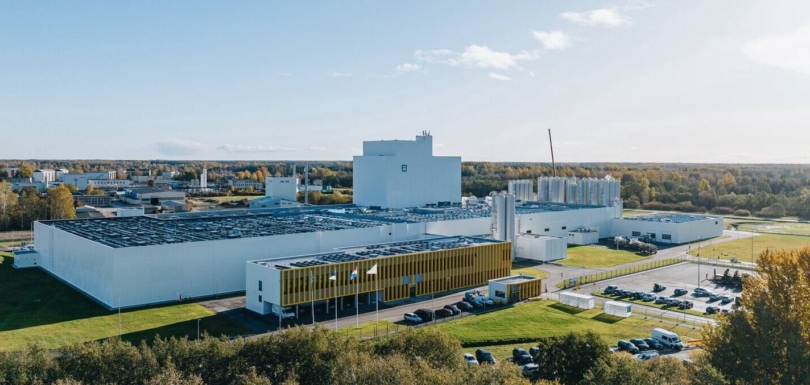
When Epiim launched its new factory in 2023, it was also decided that the entire maintenance of the plant must be digitally managed, auditable and convenient to use in daily work. “Paper and Excel files are no longer a justification for anything – especially when there are international audits and certificates at play,” says Meelis Rannaveer, Technical Manager.
Starting a new factory with Alldevice CMMS
Choosing Alldevice was not a pure chance – the solution had already been used in EPiim’s previous production, and experience confirmed that it is a tool that focuses more specifically on maintenance, which greatly simplifies the work. Decision was made to start with critical control points (CCPs) and regular control points (RCPs) in the new factory – and precisely those processes where making a mistake has a very high price and is irreversible. “Temperature monitoring, pasteurizers, metal detectors, pressure sensors – these are places where you can’t make a mistake,” Rannaveer describes.
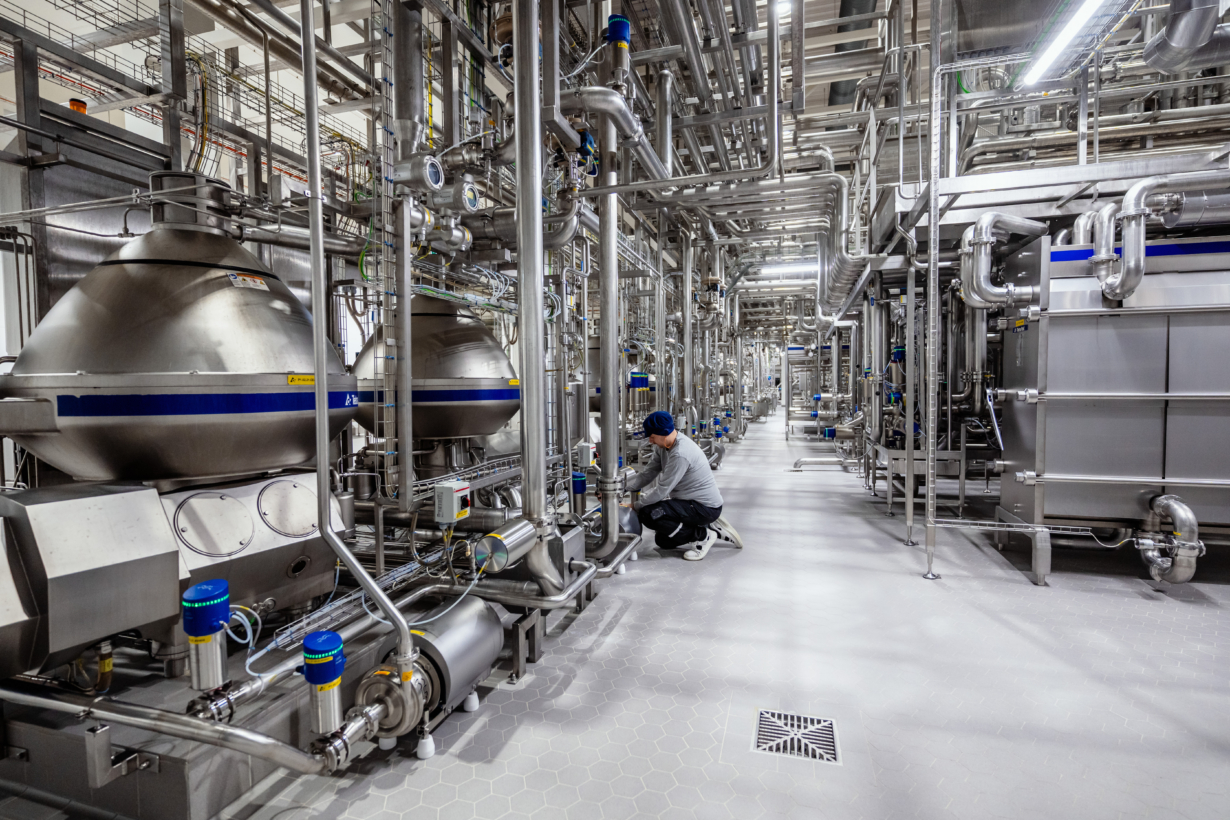
From there, the use of the system began to be expanded organically: the equipment trees were updated on an ongoing basis, the processes of checking and replacing filters were standardized, and logging regular operations became a natural part of everyday work, not a side activity. For example, in powder production, the life and control of filters is a particularly sensitive topic – Alldevice helped to make it visible, repeatable and enabled follow-ups.
We wanted to make sure that the data would remain even if several bad circumstances coincided.

Meelis Rannaveer, Technical Manager of Epiim
Why Alldevice?
- Focus on treatments. The strength of Alldevice is its maintenance logic: device maps, work orders, logs, and the ability to go down to the details in a technical view. “You can define what is specifically asked for – bearing size, pipe diameter, valve type – just as you need for our equipment,” describes the technical manager.
- Building a device tree makes sense. The structure can be designed according to the structure of your own factory. In the new factory, this is an ongoing process and will continue for a few more years – because in parallel, the documentation and the set of manuals will also be updated. “Alldevice is a tool that grows and evolves with the factory.”
- Auditability and reliability. External audits, customer audits, and food industry standards put care at the heart of it. Alldevice’s logs, consistent tracking and role-based workflow create assurance that the “proof” is always available and easy to find. “This was one of our initial needs and a reason to look towards a digital solution,” Rannaveer recalls.
- Security and backup. Web-based use and clear backup logic also provided confidence for scenarios where cyber risks come into play. “We wanted to make sure that the data would remain even if several bad circumstances coincided,” says the CTO.
- Support and training in Estonian. Estonian-language user support and practice-oriented training made the launch smooth – the phone is answered whenever you need to ask something, online trainings can be agreed on in advance and, if necessary, recorded. It sounds simple, but managing change is often the most difficult.
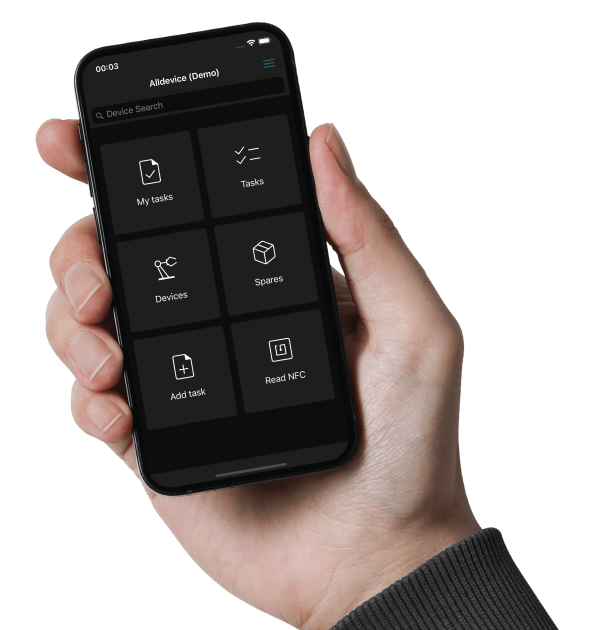
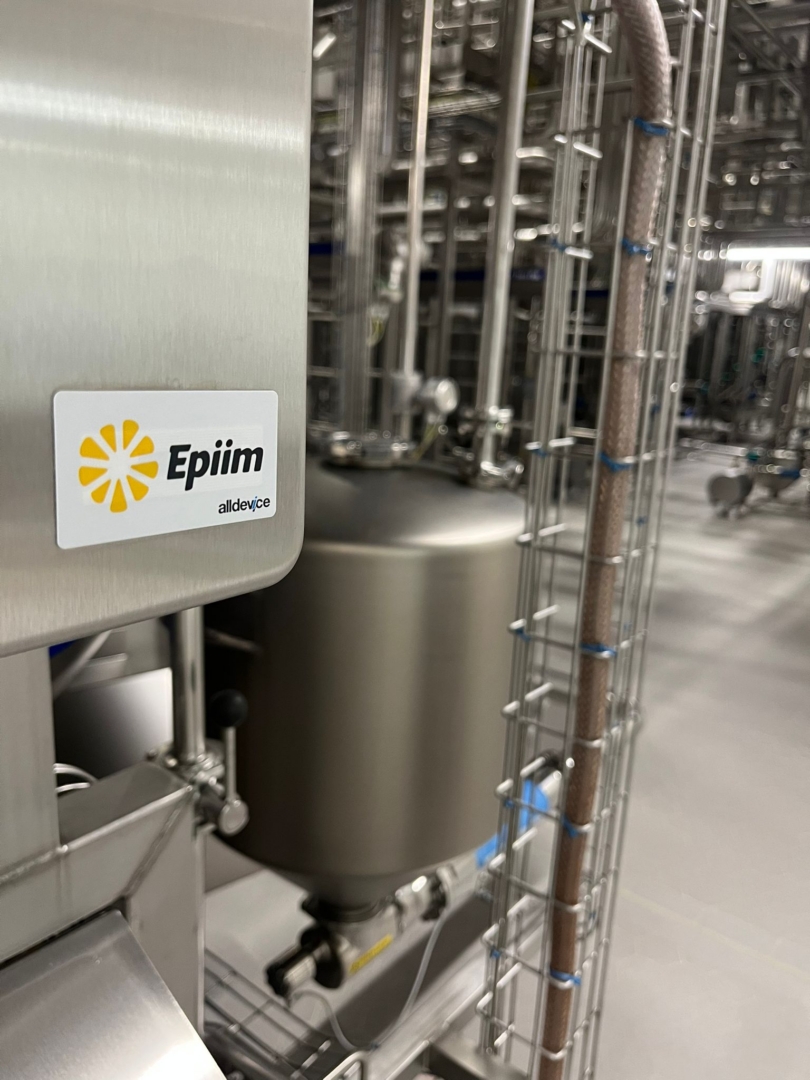
- Smart shopfloor – NFC tags. The new factory uses NFC tags, which speed up the availability of information at the line and help reduce errors. “We even had NFC tags designed with our logo,” Rannaveer smiles.
ERP vs specialized maintenance software
Epiim considered two scenarios when launching the new factory: to further develop the Microsoft Dynamics maintenance module or to keep the maintenance in a specialized system, and to link spare parts and inventory accounting through ERP. The choice fell in favor of the second option: Alldevice for maintenance + Dynamics for spare parts and finance. The reason is simple: ERP focuses on time and money, while Alldevice focuses on technical maintenance and its logics. Today’s reality is this: the company uses the Alldevice 2.0 version, which does not have an API interface – therefore, there is no fully automatic data exchange at the moment. At the same time, version changes have been discussed with the AD team – with the aim of finding a solution that allows the necessary interfaces to be created without sacrificing the main logic of maintenance.
Metrics and impact
With the new plant at full capacity, collecting and normalizing numbers is a process that takes time. “At the current stage, we have not yet measured all the impacts,” says Rannaveer. “But our key metric is clear – it is downtime. Every minute of downtime costs money. And if we have a ‘before-after’ comparison, the value will come out unambiguously.”
“Our key metric is clear – it is downtime. Every minute of downtime costs money. And if we have a ‘before-after’ comparison, the value will come out unambiguously.”
It is important that Alldevice also laid the foundation for several process updates – maintenance is now planned and carried out with a uniform logic, control and maintenance points are visible, logs are always available for audits, and the team can quickly access exactly the information they really need at that moment. This creates the ground for it to be possible to start monitoring more complex statistics during the next year, e.g.:
- MTBF/MTTR trends (time between failures and time to recovery),
- planned vs. unplanned downtime,
- discipline of work order execution (SLA, delays),
- turnover and availability of spare parts,
- decrease in audit findings (maintenance observations).
How Epiim started – and what others should take into account
1) Start with CCPs. Be the first to put critical and irreversible processes in Alldevice: pasteurizers, detectors, X-rays, pressure sensors. This protects quality and reduces risks.
2) Build a device tree step by step. Let the structure develop with the plant. Today, the construction of the equipment tree at EPiim is “underway and will continue for years to come” – and this is normal, not a problem.
3) Standardize routine activities. Filter inspection and replacement procedures, periodic inspections, lubrications – turn them into repeated, measurable and auditable workflows.
4) Simplify shopfloor activities – There is no need to overthink the logic of NFC/QR tags: they save time, while confirming the execution of the work, while reducing errors in manual inputs.
5) Keep your people informed. Estonian-language user support and training make it easier for you to start using a new tool. When the helpline is answered and all questions are resolved promptly, trust and pace also increase.
6) Plan interfaces with ERP from the outset. Map out what data you want to exchange with the ERP (e.g. spare parts, stock balances, financial metrics) and use a version that supports API integrations.
Advantages of Alldevice based on Epiim’s experience
- Specialized maintenance tool: in-depth equipment information, work orders, and complete service history.
- Flexible equipment tree: The structure corresponds to the actual architecture of the factory, not the other way around.
- Audit readiness: Transparent follow-up – take evidence immediately and is suitable for both client and certificate audits.
- Secure and backed-up: Online presence and backup provide confidence even in the event of cyber incidents.
- User-friendliness on the shopfloor: NFC/QR marking makes work faster and easier.
- Local support and training: support in Estonian, quick response and practical training.
- Clear “division of labor” with ERP: if the use of an API is possible, the invoicing and finances of spare parts can be linked so that each system does exactly what it does best.
What next?
Epiim’s technical team continues to update the Alldevice device tree, update manuals and polish routines related to use. If an API-enabled version is introduced, spare parts accounting and inventory data will also be linked to the ERP – according to the original plan. “Digitalization is not a project, but consistent work – if you start from the right place, it will quickly pay for itself in terms of downtime and reliability,” Rannaveer concludes.
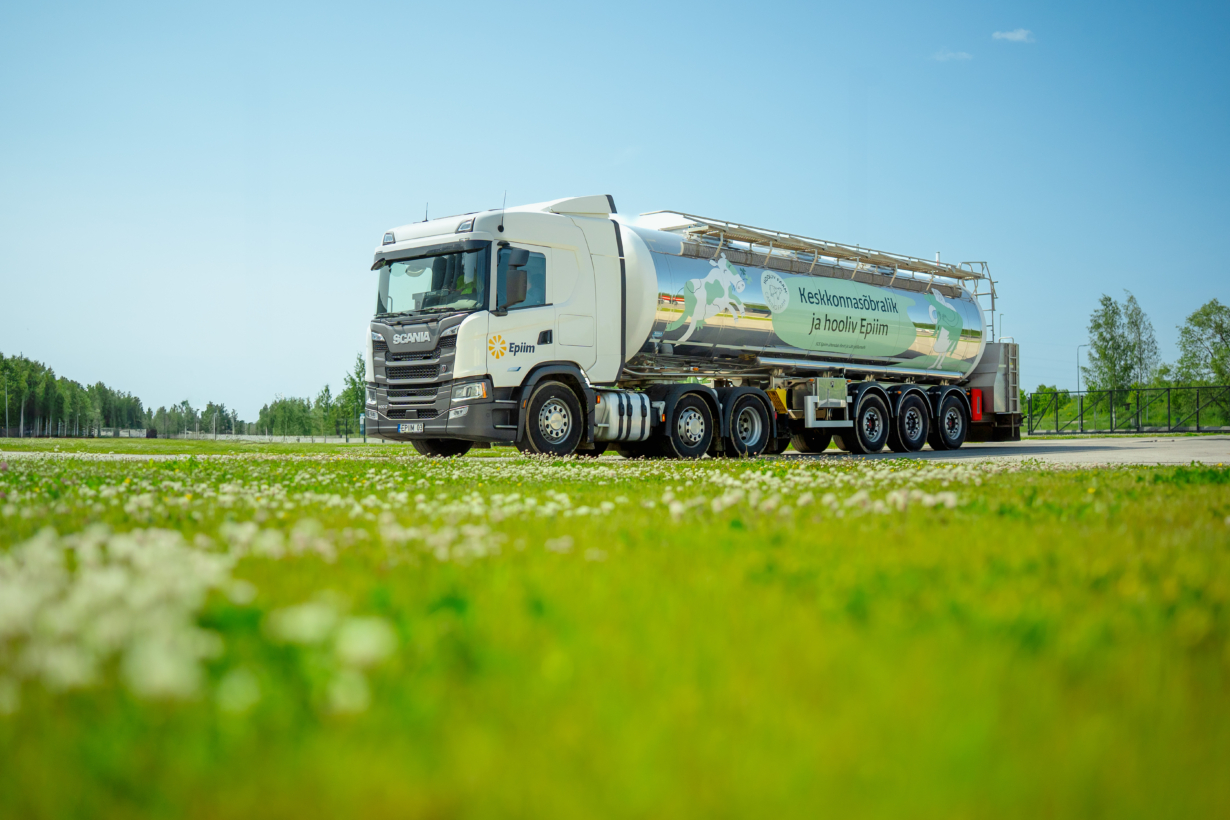
Table of Contents
Table of Contents
Related posts

From Clutter to Control in the Port of Tallinn
Three years ago, the energy department of the Port of Tallinn (AS Tallinna Sadam) concluded that over 3000 devices on their technical network would benefit from a central maintenance management system.
A Brand New Level of Device Maintenance – Kliimakaubamaja
Kliimakaubamaja OÜ, a seller, installer and provider of maintenance of air conditioning equipment and systems, has been using Alldevice equipment...

Alldevice Modernised the Production in 3MS Machinery

How Narbutas Revolutionised Its Maintenance Management with Alldevice
Bring your maintenance to the next level with Alldevice CMMS